 No image available


Specifications
- Frequency, min
- 0.01 Hz
- Frequency, max
- 20 MHz
- Waveforms
- sine, triangle, square, positive and negative pulses
- Output, max
- 30 Vpp
- Output impedance
- 50 Ω
- Modulation
- AM 0–100% and FM, internal or external
- Distortion
- 0.5 %
- Frequency stability
- ≤ 3·10⁻³ / 7 h; ≤ 2·10⁻³ / 15 min
- Display
- 3½ digits
- Power supply
- 220 V ±10%, 50/60 Hz
- Power consumption
- 80 VA
- Dimensions
- 295 × 150 × 365 mm (W × H × D)
- Weight
- 7 kg
Description
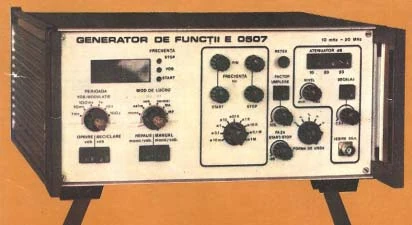
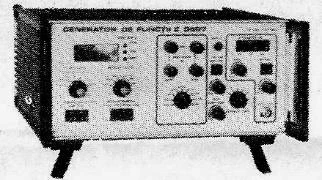
The E0507 is a function generator, made by IEMI in Bucharest and designed at the ICE research institute [1].
ICE’s laboratory for electronic instruments for measuring electrical quantities designed all the institute’s generations of oscilloscopes, voltmeters, multimeters, signal generators, frequency meters, logic analysers, RLC bridges and stabilised AC power supplies; they went into production at IEMI or in ICE’s own microproduction workshop, and equipped industrial laboratories and production lines as well as teaching and research laboratories [1]. In the 1970s and 1980s about half of the components of measuring instruments were imported; after 1980 about three quarters were Romanian [1].
It gives sine, triangular and square signals and positive and negative pulses; it was made after 1985 [2].
Annex III.2.9 gives 10 mHz – 20 MHz and up to 30 Vpp (15 Vpp into 50 Ω), with periodic, single or burst signals triggered internally, manually or externally, swept signals, internal or external amplitude and frequency modulation, and pulses or ramps with an adjustable duty cycle (10–90%); the frequency was shown on 3½ digits. It was a general-purpose signal source for designing and testing circuits in research and factory laboratories, education and medicine [3].
The Agenda radioelectronistului (2nd edition, 1989) lists the „E-0507” („Generator de funcții”, function generator) among the generators of the E-05 group made by IEMI; a note says that it produces sine, square and triangular waves, ramps and pulses (the square waves and pulses can be offset above or below zero), measures and shows the frequency (LED, printed „8 1/2” digits) and can be swept or modulated [4]. Its table gives for sine waves a range of 10⁻³ Hz…20 MHz, a long-term drift of ≤ 3·10⁻³ per 7 hours, a short-term drift of ≤ 2·10⁻³ per 15 minutes, a maximum open-circuit output of 30 Vpp, an output impedance of 50 Ω and a distortion of 0.5 %; for square waves a range of 10⁻³ Hz…20 MHz, a maximum open-circuit output of 30 Vpp, an output impedance of 50 Ω and rise and fall times of < 15 ns; a 220 V supply, at most 80 VA, 15 × 29 × 36 cm (height × width × depth) and at most 7 kg [4].
The prospectus in annex III.2.9 of „O istorie trăită” gives a 3½-digit frequency display [3].
Photo Gallery
 No image available
Schematics
No schematics available yet.
Documents
No documents available yet.
Prices
N/A
References
- [1]N. Millea (coord.) et al. – „Electronica românească. O istorie trăită”, vol. II „Electronica profesională”, AGIR, section II.4.1 „Laborator aparate electronice pentru măsurarea mărimilor electrice”, pp. 109–115
- [2]N. Millea (coord.) et al. – „Electronica românească. O istorie trăită”, vol. II „Electronica profesională”, AGIR, sections III.2 „Producția IEMI” and III.3 „Comentarii tehnico-economice”, pp. 302–317, and annex III.2.3 „Producția IEMI – aparate electronice de măsură și industriale”, pp. 383–386
- [3]N. Millea (coord.) et al. – „Electronica românească. O istorie trăită”, vol. II „Electronica profesională”, AGIR, annex III.2.9 „Generatoare de semnal”, pp. 628–633
- [4]N. Drăgulănescu – „Agenda radioelectronistului”, 2nd edition, Editura Tehnică, 1989, section 50.4 „Generatoare” (producător: IEMI – București), pp. 715–717
- [5]N. Millea, I. Constantinescu (coord.) – „Un secol de electronică în România”, Editura Academiei Române, 2020, p. 121