 No image available


Specifications
- Function
- strain (1 channel), resistive or inductive transducers
- Measuring ranges
- 0 … ±100,000 µm/m (10 ranges)
- Frequency range
- 0–1000 Hz (dynamic); 5 kHz carrier
- Accuracy
- 1.5% (non-linearity 0.25%)
- Outputs / interface
- ±10 mA (max 100 Ω); ±1 V (min 2 kΩ)
- Power supply
- 220 V +10% / −15%, 50 Hz, or 11–15 V Ni-Cd battery
- Power consumption
- max 10 VA
- Dimensions
- 180 × 275 × 380 mm (W × H × D)
- Weight
- 8 kg
Description
The N2301 is a single-channel strain gauge instrument, made by IEMI in Bucharest and designed at the ICE research institute in Bucharest [1]. It was exported to East Germany in 1971–1974 [1].
ICE’s laboratory for electronic instruments for measuring non-electrical quantities designed approved prototypes for many branches of the economy: strain gauge equipment (some configurations were exported to East Germany in 1971–1974 and 1977–1989), vibration meters, dimensional gauges, ultrasonic non-destructive testers, geophysical well-logging equipment and railway equipment [1]. Its designs were made in series at IEMI (27 types) and at the Precision Mechanics Enterprise (5 types), or in ICE’s microproduction workshop (45 types) for small series and one-off models [1].
IEMI’s production table lists 1,444 units made in 1973–1979 [2].
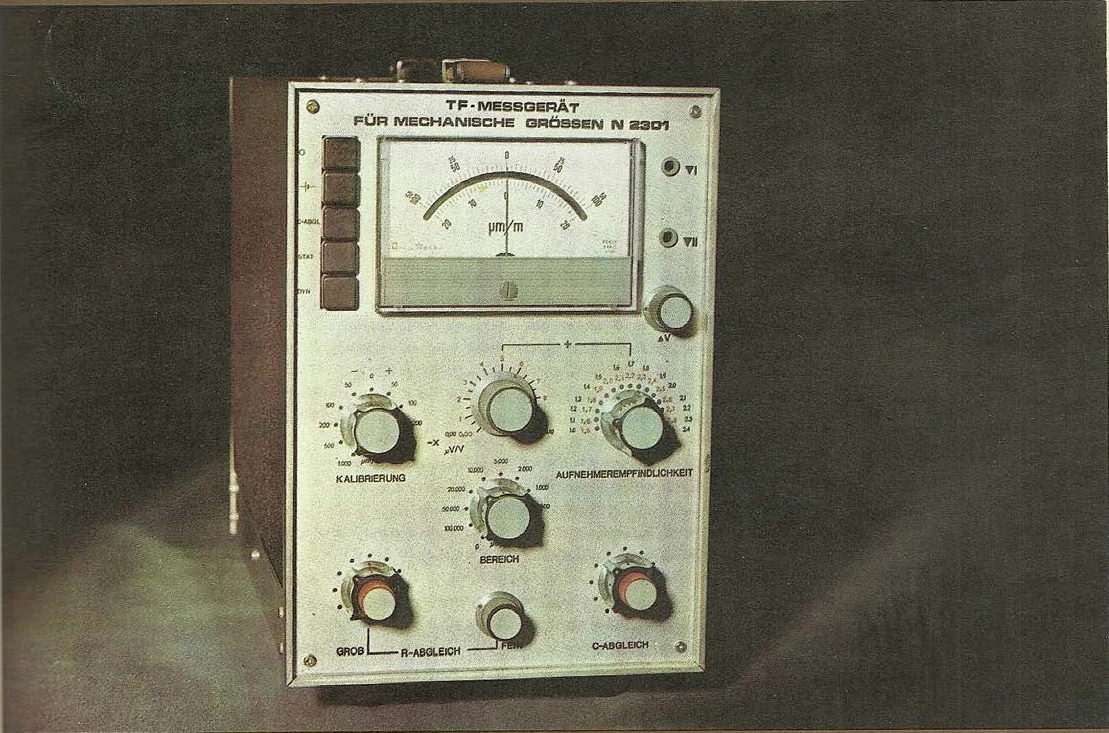
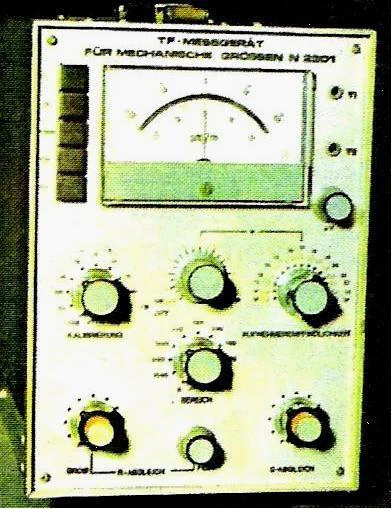
Annex III.2.12 describes the N 2301 and the six-channel N2302 as direct-reading instruments measuring mechanical quantities with resistive or inductive transducers at one or six points at once, from 0 to ±100,000 µm/m in 10 ranges (the most sensitive 100 µm/m at a bridge supply of 4 V rms, 50 µm/m at 8 V), with a dynamic bandwidth of 0–1000 Hz, a 5 kHz carrier, current (±10 mA) and voltage (±1 V) outputs and a basic error of 1.5%; they ran from the mains or from an external 11–15 V Ni-Cd battery. The N 2301 took resistive transducers of 60–1000 Ω (gauge factor 1.5–3) or inductive ones of 2–10 mH, with a bridge supply of 1, 2, 4 or 8 V rms. In the annex’s photograph its front panel is lettered in German („TF-Messgerät für mechanische Grössen”) [3].
The Agenda radioelectronistului (2nd edition, 1989) lists the „N 2301” („Tensometru electronic 1 canal”, one-channel electronic strain gauge) among the electronic strain gauge instruments of the N-23 group made by IEMI; a note says that, with suitable resistive or inductive strain-gauge transducers, the instruments of the group measure, statically or dynamically, non-electrical quantities such as strains, forces, torques, pressures, displacements and vibration parameters [4]. Its table gives a measuring range of 0…±10⁵ µm/m, a non-linearity error of at most ±0.25 %, a 5 kHz (±3 %) carrier, bridge supply voltages of 1, 2, 4 or 8 V rms, a dynamic bandwidth of 10³ Hz, resistive transducers of 60…10³ Ω or inductive ones of 2…10 mH, an output signal of 0…±1 V / 0…±10 mA, an internal calibration signal of ±50…±10³ µm/m, a resistive balancing range of at least 2 %, a capacitive balancing range of 0…900 pF, a 220 V supply, at most 10 VA, 25 × 18 × 34 cm (height × width × depth) and at most 8 kg [4].
The exponent of the calibration signal is blurred in the 2nd edition; the 1st edition (1983) reads ±50…±10³ µm/m, which matches the ±50…±1,000 µm/m of the prospectus in annex III.2.12 of „O istorie trăită” [5][3]. The 1st edition, which gives the producers of the group as „I.E.M.I., I.C.S.I.T.E.” (Bucharest), has the same values (with a tolerance of ±15 % on the bridge supply voltages) and adds a 220 V AC or 12 V DC supply, a consumption of at most 10 VA or 3 W and an ambient temperature range of −5…+40 °C [5].
The IEMI catalogue 1980 shows the N 2301 only in a photo, its text page being blank; its front panel is inscribed in German „TF-Messgerät für mechanische Grössen N 2301” (carrier-frequency instrument for mechanical quantities) [7]. The same catalogue says that the N 2300 modular system replaces the N 2301, N 2302 and N 2304 strain gauges, made in Romania for a number of years [7].
Photo Gallery
 No image available
Schematics
No schematics available yet.
Documents
No documents available yet.
Prices
N/A
References
- [1]N. Millea (coord.) et al. – „Electronica românească. O istorie trăită”, vol. II „Electronica profesională”, AGIR, section II.4.2 „Laborator aparate electronice pentru măsurarea mărimilor neelectrice și aplicații industriale”, pp. 116–122
- [2]N. Millea (coord.) et al. – „Electronica românească. O istorie trăită”, vol. II „Electronica profesională”, AGIR, sections III.2 „Producția IEMI” and III.3 „Comentarii tehnico-economice”, pp. 302–317, and annex III.2.3 „Producția IEMI – aparate electronice de măsură și industriale”, pp. 383–386
- [3]N. Millea (coord.) et al. – „Electronica românească. O istorie trăită”, vol. II „Electronica profesională”, AGIR, annex III.2.12 „Sistem tensometric modular N 2300”, pp. 656–665
- [4]N. Drăgulănescu – „Agenda radioelectronistului”, 2nd edition, Editura Tehnică, 1989, section 50.6 „Tensometre electronice” (producător: IEMI – București), pp. 722–724
- [5]N. Drăgulănescu – „Agenda radioelectronistului”, 1st edition, Editura Tehnică, 1983, section 5.6 „Tensometre electronice (grupa N-23)” (producători: I.E.M.I., I.C.S.I.T.E. – București), pp. 590–591
- [6]N. Millea, I. Constantinescu (coord.) – „Un secol de electronică în România”, Editura Academiei Române, 2020, p. 126
- [7]Measuring Electronic Instruments Enterprise (I.E.M.I.), Bucharest – „catalogue 1980” (in English), section III „Electronic instruments for nonelectrical quantities measurement”, „N 2301” (photo only) (unnumbered pages)