 No image available


Specifications
- Function
- DC voltage
- Measuring ranges
- 0.2 / 2 / 20 / 200 / 1000 V
- Accuracy
- ±(0.02% of reading + 0.01% of full scale)
- Input impedance
- 1000 MΩ (0.2 and 2 V), 10 MΩ (higher ranges)
- Display
- 4½ digits, LED
- Outputs / interface
- BCD 1-2-4-8, TTL levels (printer)
- Construction
- integrated circuits
- Power supply
- 220 V ±10%
- Power consumption
- 55 VA
- Dimensions
- 15 × 30 × 37 cm (H × W × D)
- Weight
- 7 kg
Description
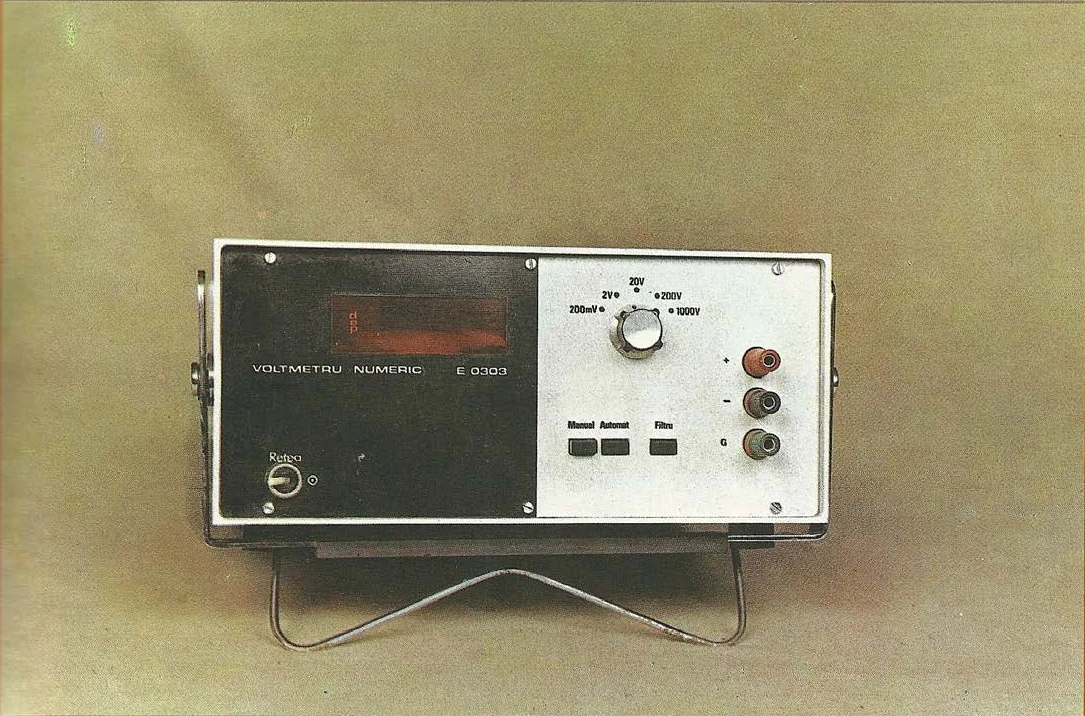
The E0303 is a digital voltmeter, made by IEMI in Bucharest and designed at the ICE research institute [1].
ICE’s laboratory for electronic instruments for measuring electrical quantities designed all the institute’s generations of oscilloscopes, voltmeters, multimeters, signal generators, frequency meters, logic analysers, RLC bridges and stabilised AC power supplies; they went into production at IEMI or in ICE’s own microproduction workshop, and equipped industrial laboratories and production lines as well as teaching and research laboratories [1]. In the 1970s and 1980s about half of the components of measuring instruments were imported; after 1980 about three quarters were Romanian [1].
It measures DC voltage [2]. IEMI’s production table lists 2,441 units made in 1971–1985 [2].
Its list price, set in 1982, was 21,000 lei [3].
Annex III.2.8 says it was built with integrated circuits and silicon semiconductor devices and measured DC voltages up to 1000 V with a resolution of up to 10 µV; its binary-coded decimal outputs (1-2-4-8 code, TTL levels) could drive a printer [4].
The Agenda radioelectronistului (2nd edition, 1989) lists the „E-0303” („Voltmetru numeric (4 1/2 cifre)”, digital voltmeter with 4½ digits) among the digital voltmeters and multimeters of the E-03 group made by IEMI; the notes to its entry give a light-emitting-diode display [5]. Its table gives DC voltages of 10⁻⁶…10³ V (±0.01 % of reading, ±0.01 % of full scale), an input resistance of 10³…10 MΩ, a 220 V supply, a consumption of at most 55 VA, 15 × 30 × 37 cm (height × width × depth) and at most 7 kg [5]. In the table, „ct” means reading („citire”) and „c.s.” full scale („cap de scară”) [5].
The IEMI catalogue 1980 presents it as the „E 0303 digital voltmeter”, a laboratory instrument with integrated circuits and semiconductor devices for DC voltages, with an LED display and linearly coded decimal outputs for the readout [6]. It works on the dual-slope integration principle; the attenuators, amplifiers, converter and floating input units are inside a guard that communicates with the main logic and the counting/display block through an isolating block, so that the measured voltage is isolated from the outputs; the input amplifier has a very high impedance on the most sensitive ranges, a low input current, a low voltage drift and the maximum resolution [6].
Its table gives 0–1,000 V with a maximum resolution of 10 µV; an accuracy of ±0.01 % of reading ±0.01 % of scale in 24 hours (25 °C), ±0.02 % of reading ±0.01 % of scale in 10 days and, in 90 days, ±0.01 % of scale on 0.2, 2 and 20 V (as printed) and ±0.05 % of reading ±0.01 % of scale on 200 and 1,000 V; automatic (min. 10 readings/s), manual or external triggering; an input current of 300 pA; automatic polarity, a floating and guarded input, an automatic overrange display and a display printed „7 digits LED”; a common-mode rejection (1 kΩ unbalance) of 120 dB DC, 100 dB at 50 Hz ±1 % without the filter and 125 dB with it; a series-mode rejection at 50 Hz ±1 % of 35 dB without and 60 dB with the filter; a temperature factor of ±0.002 % of reading/°C (0.2–20 V) and ±0.003 % (200 and 1,000 V); BCD outputs in 1248 code; +5 to +40 °C, 220 V / 50 Hz, 55 VA, max. 80 % humidity at 20 °C, 300 × 155 × 295 mm and 7 kg [6]. Its ranges are 200 mV (10 µV, 1,000 MΩ, end of scale 199.99), 2 V (100 µV, 5,000 MΩ, 1.9999), 20 V (1 mV, 5,000 MΩ, 19.999), 200 V (10 mV, 10 MΩ, 199.99) and 1,000 V (100 mV, 10 MΩ, 1,000.0) [6]. Its input resistances on 2 and 20 V (5,000 MΩ) differ from those in the specifications [6].
Photo Gallery
 No image available
Schematics
No schematics available yet.
Documents
No documents available yet.
Prices
N/A
References
- [1]N. Millea (coord.) et al. – „Electronica românească. O istorie trăită”, vol. II „Electronica profesională”, AGIR, section II.4.1 „Laborator aparate electronice pentru măsurarea mărimilor electrice”, pp. 109–115
- [2]N. Millea (coord.) et al. – „Electronica românească. O istorie trăită”, vol. II „Electronica profesională”, AGIR, sections III.2 „Producția IEMI” and III.3 „Comentarii tehnico-economice”, pp. 302–317, and annex III.2.3 „Producția IEMI – aparate electronice de măsură și industriale”, pp. 383–386
- [3]N. Millea (coord.) et al. – „Electronica românească. O istorie trăită”, vol. II „Electronica profesională”, AGIR, annex III.2.5 „Lista cu prețurile produselor – IEMI”, pp. 393–396
- [4]N. Millea (coord.) et al. – „Electronica românească. O istorie trăită”, vol. II „Electronica profesională”, AGIR, annex III.2.8 „Voltmetre – multimetre – wattmetre”, pp. 618–627
- [5]N. Drăgulănescu – „Agenda radioelectronistului”, 2nd edition, Editura Tehnică, 1989, section 50.3 „Voltmetre/multimetre numerice/analogice” (producător: IEMI – București), part B „Voltmetre/multimetre numerice (grupa E-03)”, pp. 711–713
- [6]Measuring Electronic Instruments Enterprise (I.E.M.I.), Bucharest – „catalogue 1980” (in English), section II „Electronic instruments for electric quantities measurement”, „E 0303 digital voltmeter” (unnumbered pages)